AuthorSep 2026 – present
Zig is a decision engine I built from scratch. It’s my own implementation of the decision-system idea, and for now it’s a closed, private project.
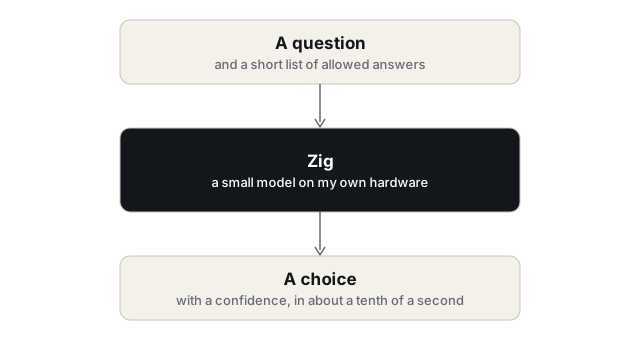
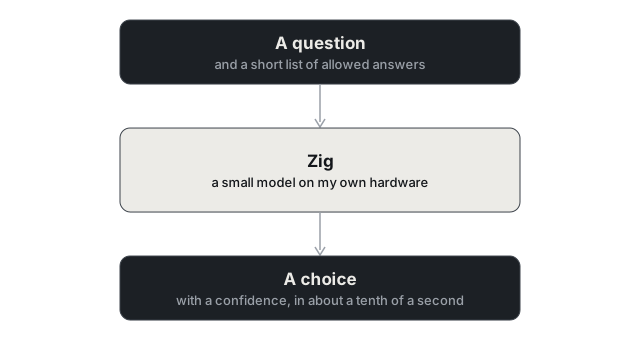
The idea is simple. Instead of asking a language model to write an answer, you give it a question and a short list of allowed answers. It picks one and tells you how sure it is. No rambling, no formatting to parse, nothing to go wrong in the output. Is this a bug report or a feature request? How serious is it? Does this screenshot show an error?
How fast, how many
It runs on my own hardware, so a decision costs nothing per call and nothing leaves the machine. The typical answer takes about a tenth of a second. I’ve now made over 1.1 million decisions with it, and that number grows every day as more of my tools lean on it.
Where it’s used
Zig is the quiet engine behind a lot of my other projects: it sorts and rates stories in Insights, classifies the flaw type and affected software on CVE-20XX-?, decides how urgent an anomaly is in my smart home, and helps the diagnostic plugins in WLP. It also runs in my terminal and IDE as a “what should I do next” helper. Everything reaches it through the Inference Gateway.
It’s never a hard dependency. Every project works without it, just with simpler rules.
Why I like it
Plain code stays plain code. Zig only gets the questions that need judgment, and it comes back with a confidence, so the caller can decide what to do when it isn’t sure. That makes it easy to measure, easy to trust a little at a time, and hard to surprise me.
It’s not open yet. If you’re curious, or you have a decision problem of your own, ask me.